Wednesday, February 7, 2007

Beauty of the Moon


Carefully observe the difference between the two.

The moon though a sphere in reality does not look like a sphere. Instead it looks like a disc. A sphere has lesser intensity in the sides. But the beauty of the moon lies in the uniformity of its intensity. Similarly the sun also looks like a disc.

This is because natural sources like the sun and moon do not emit isotropically(same intensity at all directions). Instead they emit as lambertian sources (a plane that emits a flux proportional to the cosine of the angle of the normal).

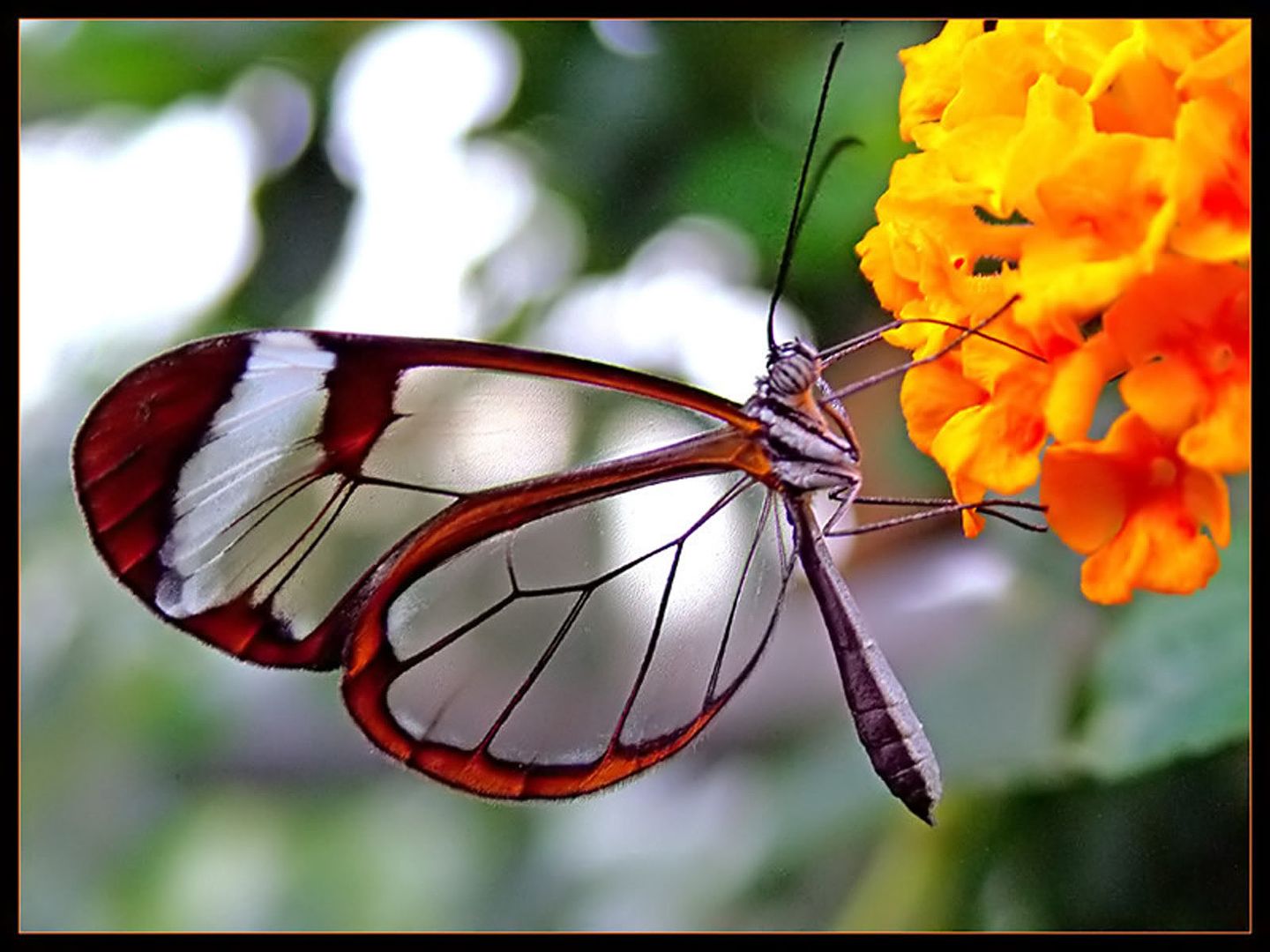
Butterflies

Photonic Crystals


Butterflies are one of the most colourful creatures. But then not all butterflies have pigments.

Some of these colours are attributed to "photonic crystals". If you see a red colour it means, red colour is being reflected while the other colours may either go through or get absorbed. In the picture, at certain regions no colour is reflected.

As explained in the earlier post we can obtain a low refractive index materials by making voids in a solid. But this is true only when the spacing of these voids is random. Instead if the voids form a particular pattern then we find that the mixture shows wavelength dependent optical properties. Such unique materials containing a mixture in a definite pattern are called photonic crystals.

More fascinating property being, sometimes these materials allow all colours to pass through except a specific colour also know as the photonic bandgap. This colour is thus reflected as it cant pass through.

How does this help the butterfly? But having well spaced voids, the butterfly has stronger yet lighter wings.

Smaller than Light!

Low refractive index materials

If you want to the know the basic optical properties (like reflection, refraction etc) of a material, you need to know its refractive index. The index of some materials

air = 1.003 ~ 1
water = 1.33
glass = 1.5
diamond = 2.414

You can notice that denser the material the index in general increases. The lowest index among available solids is around 1.45.

But then for certain opto-electronic applications we need an index from 1.05 to 1.45 only using solids. Can we mix two materials? How about a solid with voids? If we have voids in glass, we may visualize that it will have an index between 1 and 1.5 depending on the size of the voids.

But can light be duped to think that it is one material and not a mixture of two different materials? In reality, YES. If the sizes are smaller than light itself! Here is the challenge to make small voids of sizes much smaller than light's wavelength.